
Determining Strategic Locations for a Mobile Coffee Business at Obbel Coffee Boyolali Using the Analytical Hierarchy Process (AHP)
Bilah Samping Artikel
Isi Artikel Utama
Abstrak
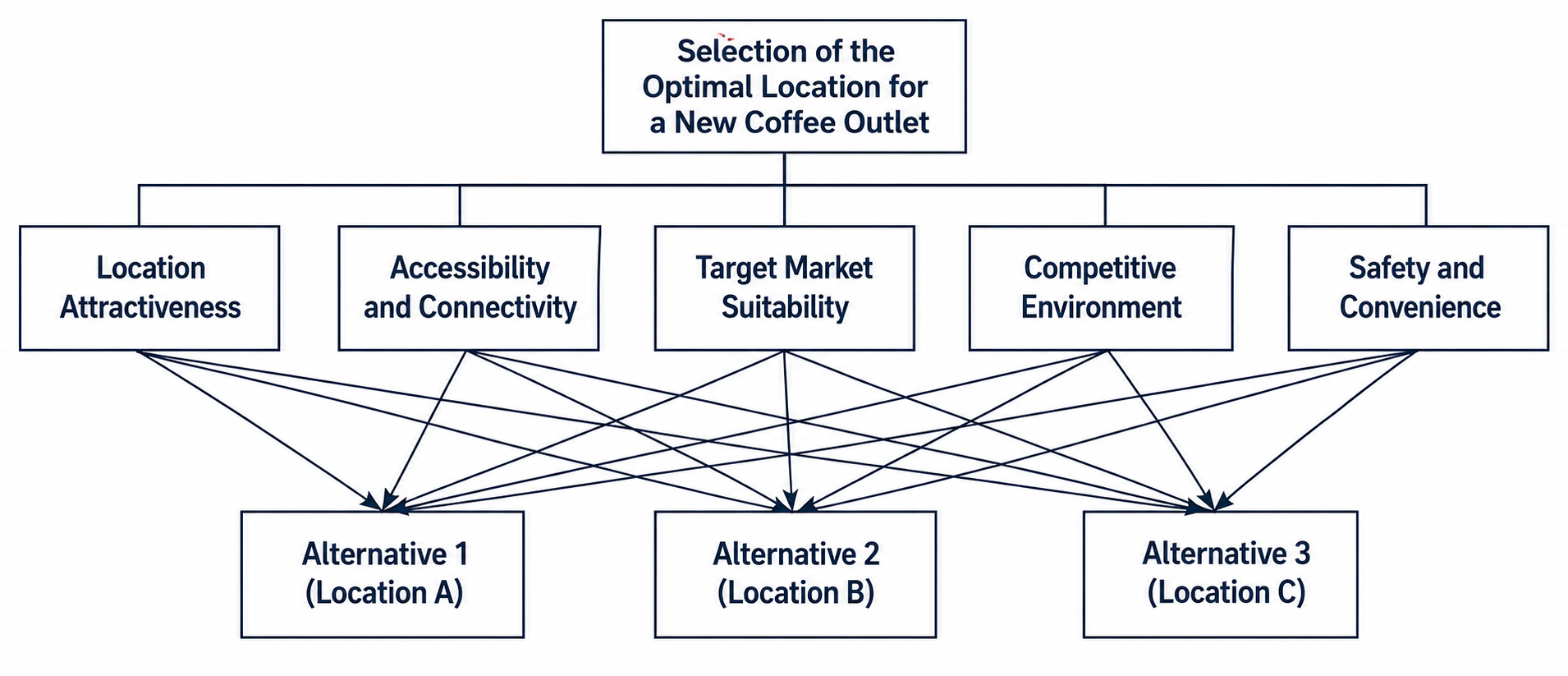
The growth of micro, small, and medium enterprises (MSMEs) in the coffee industry has encouraged business owners to pursue expansion strategies to strengthen competitiveness and extend market coverage. One such strategy undertaken by Obbel Coffee Boyolali, Indonesia, is the expansion of its mobile coffee outlet operations. The selection of an appropriate operating location represents a critical decision, as it involves multiple criteria and may be influenced by subjective judgments. This study aims to identify the most suitable location for the operational expansion of Obbel Coffee using the Analytical Hierarchy Process (AHP). A quantitative approach with a case study design was employed. Data were collected through interviews and pairwise comparison questionnaires involving three respondents with relevant knowledge and experience of the business operations. Five criteria were incorporated into the decision-making framework: crowd density, accessibility, target-consumer suitability, competition intensity, and location safety and convenience. The results indicate that crowd density received the highest priority weight (0.249), followed by target-consumer suitability (0.159) and location safety and convenience (0.152). Among the evaluated alternatives, location A1 achieved the highest overall priority score (0.291), followed by A2 (0.281) and A3 (0.227). Accordingly, A1 was identified as the most suitable location for the operational expansion of Obbel Coffee. These findings demonstrate that AHP provides a systematic, structured, and transparent decision-support framework for MSMEs in addressing multi-criteria location selection problems and supporting strategic business expansion decisions.
##plugins.themes.bootstrap3.displayStats.downloads##
Rincian Artikel
Terbitan
Bagian

Artikel ini berlisensiCreative Commons Attribution-ShareAlike 4.0 International License.
Cara Mengutip
Referensi
[1] R. A. Mughni, “Marketing Mix Dan Perilaku Konsumen Kedai Kopi Di Kecamatan Majalaya,” Mimb. Agribisnis J. Pemikir. Masy. Ilmiah Berwawasan Agribisnis, 2023, https://doi.org/10.25157/ma.v9i1.8973.
[2] S. H. Kholifah, N. Rusti, and K. M. Nur, “Pengaruh Kualitas Pelayanan, Lokasi, Dan Harga Terhadap Kepuasan Konsumen (Study Kasus Coffee Shop Kopi Pelarian),” J. Javanica, vol. 2, no. 2, pp. 114–124, Dec. 2023, https://doi.org/10.57203/javanica.v2i2.2023.114-124.
[3] S. Wagistina, D. R. Syafitri, J. S. Lestari, K. H. Amanatinismi, D. Setiawan, and S. Ramadhani, “Service Area Network Analysis for Location Planning of Microbusiness and Local Franchise in Urban Area: A Case Study in Malang City, East Java Provence, Indonesia,” Economies, vol. 10, no. 5, p. 103, Apr. 2022, https://doi.org/10.3390/economies10050103.
[4] T. Theodora, W. Septiani, and T. S. Dewayana, “Multi criteria decision making to determine the location of Via Laundry’s branch,” Oper. Excell. J. Appl. Ind. Eng., vol. 16, no. 1, p. 25, Jun. 2024, https://doi.org/10.22441/oe.2024.v16.i1.099.
[5] D. Diana, S. O. Kunang, and I. Seprina, “Sistem Pendukung Keputusan Pemilihan Lokasi Usaha Jasa Umkm Menerapkan Analytical Hierarchy Process –Weighted Product Method,” J. Ilm. Matrik, vol. 22, no. 2, pp. 224–231, Aug. 2020, https://doi.org/10.33557/jurnalmatrik.v22i2.1005.
[6] M. R. Ristyawan, “Geographic Information System Proposes Determination Of Business Location Feasibility: Case Study Small Business Culinary In Pontianak,” J. Manaj. Bisnis, vol. 9, no. 1, 2018, https://doi.org/10.18196/mb.9153.
[7] Q. Aini, Z. Zulfiandri, and N. Cholis, “Fuzzy Analytical Hierarchy Process: Pendekatan dalam Sistem Pendukung Keputusan Lokasi Coffee Shop,” InfoTekJar: Jurnal Nasional Informatika dan Teknologi Jaringan. 2022. https://doi.org/10.30743/infotekjar.v6i2.4924
[8] A. Fauzi, N. Indriyani, and A. Bayu Hasta Yanto, “Selection of Coffee Shop Business Locations Using the Analytical Hierarchy Process Method,” J. Teknol. dan Open Source, vol. 4, no. 2, pp. 133–140, Dec. 2021, https://doi.org/10.36378/jtos.v4i2.1771.
[9] M. Valerina R. and R. Adysholihah F., “Pengaruh Aksesibilitas dan Fasilitas terhadap Kepuasan Konsumen Halsean Coffee & Resto,” Int. J. Adm. Bus. Organ., vol. 3, no. 2, pp. 52–60, Sep. 2022, https://doi.org/10.61242/ijabo.22.210.
[10] S. M. Sophian and H. Muttaqin, “Pola Sebaran Kafe di Kota Banjarmasin: Tinjauan Analisis Teori Lokasi,” JIEP J. Ilmu Ekon. dan Pembangunan, 2023, https://doi.org/10.20527/jiep.v6i2.11077.
[11] I. B. Komang, K. Adhiarta, W. Witanti, and P. N. Sabrina, “Pemilihan Lokasi Awal Usaha Bagi Usaha Mikro Kecil Dan Menengah Dengan Metode Analitycal Hierarchy Process,” J. Inf. Technol., vol. 3, no. 2, pp. 43–46, Aug. 2021, https://doi.org/10.47292/joint.v3i2.63.
[12] A. Ishizaka and A. Labib, “Review of the main developments in the analytic hierarchy process,” Expert Syst. Appl., 2011, https://doi.org/10.1016/j.eswa.2011.04.143
[13] T. L. Saaty, “Decision making with the analytic hierarchy process,” 2008.
[14] A. Kumar and S. Pant, “Analytical hierarchy process for sustainable agriculture: An overview,” MethodsX. 2023, https://doi.org/10.1016/j.mex.2022.101954.
[15] S. Alwedyan, “Optimal location selection of a casual-dining restaurant using a multi-criteria decision-making (MCDM) approach,” Int. Rev. Spat. Plan. and Sustainable Development, 2024, https://doi.org/10.14246/irspsd.12.1_156.
[16] B. Chairina, T. Mesra, M. Belen, W. Alfian, F. R. Simanjuntak, and R. Pratama, “Penentuan Pemilihan Lokasi Usaha Terbaik Menggunakan Metode AHP dan TOPSIS,” J. Tek. Ind. Terintegrasi, vol. 9, no. 1, pp. 932–940, Jan. 2026, https://doi.org/10.31004/jutin.v9i1.54259.
[17] L. Isyriyah, R. Maulidi, and A. Z. S. A. Fandi, “Sistem Pendukung Keputusan Penentuan Lokasi Usaha Kuliner Menggunakan Metode Analytic Hierarchy Process (AHP) dan Technique for Others Reference by Similarity to Idealsolution (TOPSIS),” J. Teknol. dan Manaj. Inform., vol. 10, no. 2, pp. 176–186, Dec. 2024, https://doi.org/10.26905/jtmi.v10i2.14791.
[18] T. L. Saaty and L. G. Vargas, “Decision Making with the Analytic Network Process.” Economic, Political, Social and Technological Applications with Benefits, Opportunities, Costs and Risk, New York: Springer, 2013. https://doi.org/10.1007/0-387-33987-6