
Determining Strategic Locations for a Mobile Coffee Business at Obbel Coffee Boyolali Using the Analytical Hierarchy Process (AHP)
Article Sidebar
Main Article Content
Abstract
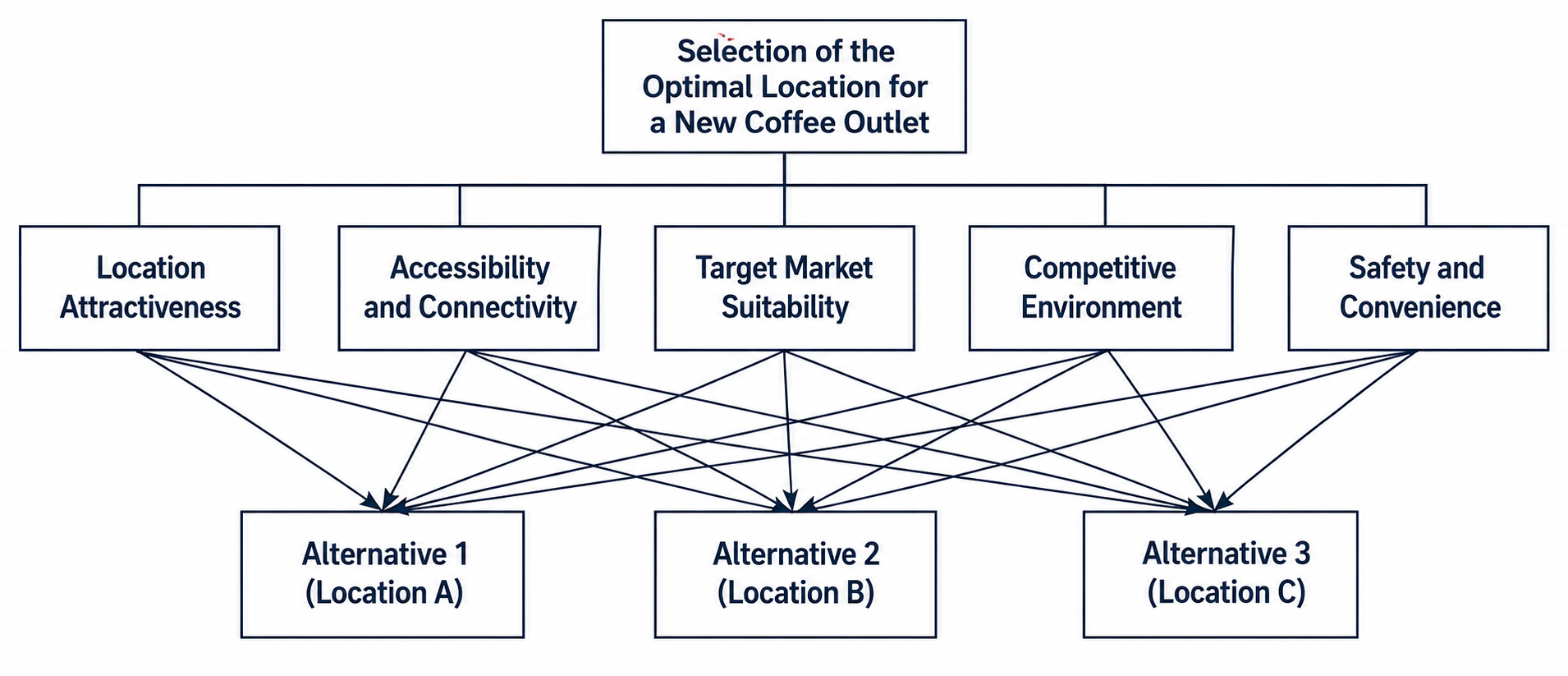
The increase in the number of micro, small, and medium enterprises (MSMEs) in the coffee sector has led business owners to adopt expansion strategies in order to improve their competitiveness and broaden their market reach. One expansion strategy that Obbel Coffee Boyolali, Indonesia, is the expansion of its mobile coffee outlet services. Making the right choice of operating location is a vital one since it requires the consideration of several factors and can be affected by personal judgments. The purpose of this study was to identify the most appropriate location for the operational expansion of Obbel Coffee by means of the Analytical Hierarchy Process (AHP). A quantitative approach using a case study method was applied. Data were gathered through interviews and pairwise comparison questionnaires from three people who have relevant knowledge and experience of Obbel Coffee's operations. The AHP process included identifying and assigning weights to five location-selection criteria: crowd density, accessibility, target-consumer suitability, competition intensity, and location safety and convenience, and then assessing three possible locations on the basis of these criteria. The results indicate that crowd density had the highest priority weight (0.249), followed by target-consumer suitability (0.159) and location safety and convenience (0.152). Of the alternative locations, A1 obtained the highest total priority score (0.291), A2 came second with a score of 0.281, and A3 had the lowest at 0.227. As a result, A1 was found to be the most suitable location for Obbel Coffee's expansion. In practice, the findings give Obbel Coffee a basis grounded in evidence when choosing an expansion site, enabling it to focus on areas with high levels of customer activity and appropriate target consumers, and thus lessen its dependence on subjective location choices. More generally, the study shows that AHP can function as a systematic and transparent decision-support tool for MSMEs when making location decisions and aiding business expansion.
Downloads
Article Details
Section

This work is licensed under a Creative Commons Attribution-ShareAlike 4.0 International License.
How to Cite
References
[1] R. A. Mughni, “Marketing Mix Dan Perilaku Konsumen Kedai Kopi Di Kecamatan Majalaya,” Mimb. Agribisnis J. Pemikir. Masy. Ilmiah Berwawasan Agribisnis, 2023, https://doi.org/10.25157/ma.v9i1.8973.
[2] S. H. Kholifah, N. Rusti, and K. M. Nur, “Pengaruh Kualitas Pelayanan, Lokasi, Dan Harga Terhadap Kepuasan Konsumen (Study Kasus Coffee Shop Kopi Pelarian),” J. Javanica, vol. 2, no. 2, pp. 114–124, Dec. 2023, https://doi.org/10.57203/javanica.v2i2.2023.114-124.
[3] S. Wagistina, D. R. Syafitri, J. S. Lestari, K. H. Amanatinismi, D. Setiawan, and S. Ramadhani, “Service Area Network Analysis for Location Planning of Microbusiness and Local Franchise in Urban Area: A Case Study in Malang City, East Java Provence, Indonesia,” Economies, vol. 10, no. 5, p. 103, Apr. 2022, https://doi.org/10.3390/economies10050103.
[4] T. Theodora, W. Septiani, and T. S. Dewayana, “Multi criteria decision making to determine the location of Via Laundry’s branch,” Oper. Excell. J. Appl. Ind. Eng., vol. 16, no. 1, p. 25, Jun. 2024, https://doi.org/10.22441/oe.2024.v16.i1.099.
[5] D. Diana, S. O. Kunang, and I. Seprina, “Sistem Pendukung Keputusan Pemilihan Lokasi Usaha Jasa Umkm Menerapkan Analytical Hierarchy Process –Weighted Product Method,” J. Ilm. Matrik, vol. 22, no. 2, pp. 224–231, Aug. 2020, https://doi.org/10.33557/jurnalmatrik.v22i2.1005.
[6] M. R. Ristyawan, “Geographic Information System Proposes Determination Of Business Location Feasibility: Case Study Small Business Culinary In Pontianak,” J. Manaj. Bisnis, vol. 9, no. 1, 2018, https://doi.org/10.18196/mb.9153.
[7] Q. Aini, Z. Zulfiandri, and N. Cholis, “Fuzzy Analytical Hierarchy Process: Pendekatan dalam Sistem Pendukung Keputusan Lokasi Coffee Shop,” InfoTekJar: Jurnal Nasional Informatika dan Teknologi Jaringan. 2022. https://doi.org/10.30743/infotekjar.v6i2.4924
[8] A. Fauzi, N. Indriyani, and A. Bayu Hasta Yanto, “Selection of Coffee Shop Business Locations Using the Analytical Hierarchy Process Method,” J. Teknol. dan Open Source, vol. 4, no. 2, pp. 133–140, Dec. 2021, https://doi.org/10.36378/jtos.v4i2.1771.
[9] M. Valerina R. and R. Adysholihah F., “Pengaruh Aksesibilitas dan Fasilitas terhadap Kepuasan Konsumen Halsean Coffee & Resto,” Int. J. Adm. Bus. Organ., vol. 3, no. 2, pp. 52–60, Sep. 2022, https://doi.org/10.61242/ijabo.22.210.
[10] S. M. Sophian and H. Muttaqin, “Pola Sebaran Kafe di Kota Banjarmasin: Tinjauan Analisis Teori Lokasi,” JIEP J. Ilmu Ekon. dan Pembangunan, 2023, https://doi.org/10.20527/jiep.v6i2.11077.
[11] I. B. Komang, K. Adhiarta, W. Witanti, and P. N. Sabrina, “Pemilihan Lokasi Awal Usaha Bagi Usaha Mikro Kecil Dan Menengah Dengan Metode Analitycal Hierarchy Process,” J. Inf. Technol., vol. 3, no. 2, pp. 43–46, Aug. 2021, https://doi.org/10.47292/joint.v3i2.63.
[12] A. Ishizaka and A. Labib, “Review of the main developments in the analytic hierarchy process,” Expert Syst. Appl., 2011, https://doi.org/10.1016/j.eswa.2011.04.143
[13] T. L. Saaty, “Decision making with the analytic hierarchy process,” 2008.
[14] A. Kumar and S. Pant, “Analytical hierarchy process for sustainable agriculture: An overview,” MethodsX. 2023, https://doi.org/10.1016/j.mex.2022.101954.
[15] S. Alwedyan, “Optimal location selection of a casual-dining restaurant using a multi-criteria decision-making (MCDM) approach,” Int. Rev. Spat. Plan. and Sustainable Development, 2024, https://doi.org/10.14246/irspsd.12.1_156.
[16] B. Chairina, T. Mesra, M. Belen, W. Alfian, F. R. Simanjuntak, and R. Pratama, “Penentuan Pemilihan Lokasi Usaha Terbaik Menggunakan Metode AHP dan TOPSIS,” J. Tek. Ind. Terintegrasi, vol. 9, no. 1, pp. 932–940, Jan. 2026, https://doi.org/10.31004/jutin.v9i1.54259.
[17] L. Isyriyah, R. Maulidi, and A. Z. S. A. Fandi, “Sistem Pendukung Keputusan Penentuan Lokasi Usaha Kuliner Menggunakan Metode Analytic Hierarchy Process (AHP) dan Technique for Others Reference by Similarity to Idealsolution (TOPSIS),” J. Teknol. dan Manaj. Inform., vol. 10, no. 2, pp. 176–186, Dec. 2024, https://doi.org/10.26905/jtmi.v10i2.14791.
[18] T. L. Saaty and L. G. Vargas, “Decision Making with the Analytic Network Process.” Economic, Political, Social and Technological Applications with Benefits, Opportunities, Costs and Risk, New York: Springer, 2013. https://doi.org/10.1007/0-387-33987-6