
Community Transformation Towards Sustainability: Strengthening Community Understanding of Low-Carbon Development
Article Sidebar
Main Article Content
Abstract
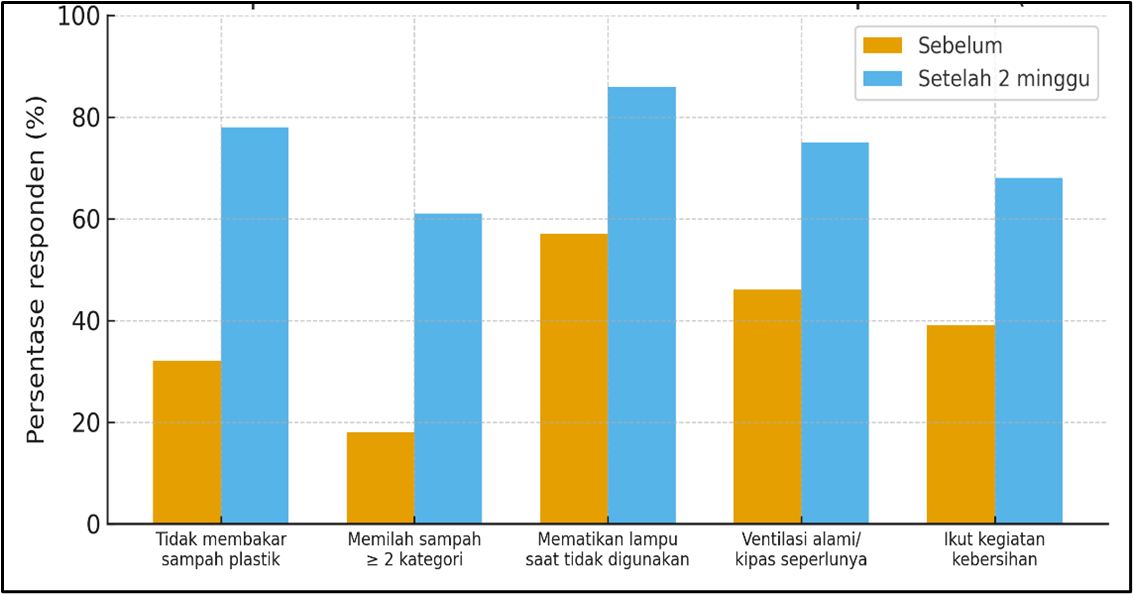
This community engagement program aims to strengthen local community understanding of Low-Carbon Development (LCD) and related household practices in a coastal village of North Konawe Regency, Southeast Sulawesi. A descriptive qualitative approach was employed, supported by simple quantitative measurements using pre-test and post-test, as well as a short follow-up behaviour survey. The program was conducted with village government, community groups, and the Environmental Agency (DLH) as partners. Twenty-eight participants took part in the education sessions and knowledge measurement, and twenty-five were surveyed two weeks after the intervention. The results show a significant increase in community knowledge on LCD and low-carbon practices, with the total average score increasing by 84.3% between pre-test and post-test. Behavioural changes were also observed, particularly reductions in open burning of plastic waste and improvements in waste separation and energy-saving practices at the household level. In addition, indications of micro-policy change emerged, as the village head committed to integrating LCD messages into regular village meetings and environmental programs. The study concludes that short, contextualized educational interventions can effectively enhance community understanding and initiate behavioural and institutional changes that support LCD at the local level.
Downloads
Article Details
Section

This work is licensed under a Creative Commons Attribution-ShareAlike 4.0 International License.
How to Cite
References
[1] I. Alviya, T. Sarker, H. Sarvaiya, and M. S. Iftekhar, “Role of the Land-Based Private Sector in Low-Emission Development: An Indonesian Case,” Sustainability, vol. 13, no. 24, p. 13811, 2021, https://doi.org/10.3390/su132413811.
[2] A. Jaeger, S. B. Nugroho, E. Zusman, R. Nakano, and R. W. Daggy, “Governing Sustainable Low‐carbon Transport in Indonesia: An Assessment of Provincial Transport Plans,” Nat. Resour. Forum, vol. 39, no. 1, pp. 27–40, 2015, https://doi.org/10.1111/1477-8947.12066.
[3] Bappenas, “Pelaporan aksi pembangunan rendah karbon melalui aplikasi,” 2022.
[4] Peraturan Presiden Republik Indonesia, “Peraturan Presiden Nomor 98 Tahun 2021 tentang Penyelenggaraan Nilai Ekonomi Karbon untuk Pencapaian Target Kontribusi yang Ditetapkan Secara Nasional dan Pengendalian Emisi Gas Rumah Kaca dalam Pembangunan Nasional,” vol. 10, no. 1, pp. 279–288, 2021.
[5] V. Bhatt, P. Friley, and J. J. Lee, “Integrated Energy and Environmental Systems Analysis Methodology for Achieving Low Carbon Cities,” J. Renew. Sustain. Energy, vol. 2, no. 3, 2010, https://doi.org/10.1063/1.3456367.
[6] H. Runhaar, B. Wilk, Å. Persson, C. Uittenbroek, and C. Wamsler, “Mainstreaming Climate Adaptation: Taking Stock About ‘What Works’ From Empirical Research Worldwide,” Reg. Environ. Chang., vol. 18, no. 4, pp. 1201–1210, 2017, https://doi.org/10.1007/s10113-017-1259-5.
[7] C. Wamsler, “Mainstreaming Ecosystem-Based Adaptation: Transformation Toward Sustainability in Urban Governance and Planning,” Ecol. Soc., vol. 20, no. 2, 2015, https://doi.org/10.5751/es-07489-200230.
[8] F. W. Geels, B. K. Sovacool, T. Schwanen, and S. Sorrell, “The Socio-Technical Dynamics of Low-Carbon Transitions,” Joule, vol. 1, no. 3, pp. 463–479, 2017, https://doi.org/10.1016/j.joule.2017.09.018.
[9] E. A. Landiyanto, “Transformation of the National Monitoring and Evaluation Arrangement in Decentralized Indonesia,” SSRN Electron. J., 2015, https://doi.org/10.2139/ssrn.2723361.
[10] S. Colenbrander, D. Dodman, and D. Mitlin, “Using Climate Finance to Advance Climate Justice: The Politics and Practice of Channelling Resources to the Local Level,” Clim. Policy, vol. 18, no. 7, pp. 902–915, 2017, https://doi.org/10.1080/14693062.2017.1388212.
[11] N. Harahab, Z. Fanani, D. Puspitawati, and A. Said, “Ketahanan Ekonomi Masyarakat Pesisir Di Kawasan Ekowisata Bahari Dusun Sendangbiru, Desa Tambakrejo, Kabupaten Malang, Provinsi Jawa Timur,” J. Ketahanan Nas., vol. 26, no. 1, p. 71, 2020, https://doi.org/10.22146/jkn.53372.
[12] H. E. Bilali, “The Multi-Level Perspective in Research on Sustainability Transitions in Agriculture and Food Systems: A Systematic Review,” Agriculture, vol. 9, no. 4, p. 74, 2019, https://doi.org/10.3390/agriculture9040074.
[13] Suyitno, “Metode Penelitian: Konsep, Prinsip dan Operasionalnya.” Center for Open Science, 2021, https://doi.org/10.31219/osf.io/auqfr.
[14] Bappenas, “Laporan Implementasi Perencanaan Pembangunan Rendah Karbon,” p. 78, 2019.
[15] M. O. Damanik and A. Y. S. Rahayu, “Kolaborasi Pencegahan Kebakaran Hutan Dan Lahan Di Provinsi Riau Ditinjau Dari Model Tata Kelola Kolaboratif,” Publikauma J. Adm. Publik Univ. Medan Area, vol. 9, no. 2, pp. 44–54, 2021, https://doi.org/10.31289/publika.v9i2.5922.
[16] T. Jurnali and A. K. Siti‐Nabiha, “Performance Management System for Local Government: The Indonesian Experience,” Glob. Bus. Rev., vol. 16, no. 3, pp. 351–363, 2015, https://doi.org/10.1177/0972150915569923.
[17] F. Farizal, R. Aji, A. Rachman, N. Nasruddin, and T. M. I. Mahlia, “Indonesia’s Municipal Solid Waste 3R and Waste to Energy Programs,” Makara J. Technol., vol. 21, no. 3, p. 153, 2018, https://doi.org/10.7454/mst.v21i3.3536.
[18] A. Hamzah and V. E. S. Paliling, “Strategic Implementation of Nationally Determined Contributions for Waste-to-Energy Utilization in Indonesia,” Indones. J. Energy, vol. 7, no. 1, pp. 58–65, 2024, https://doi.org/10.33116/ije.v7i1.200.