
Community Economic Empowerment Based on Iodized Salt Production: A Case Study of UD SNIPER, Jeneponto Regency
Article Sidebar
Main Article Content
Abstract
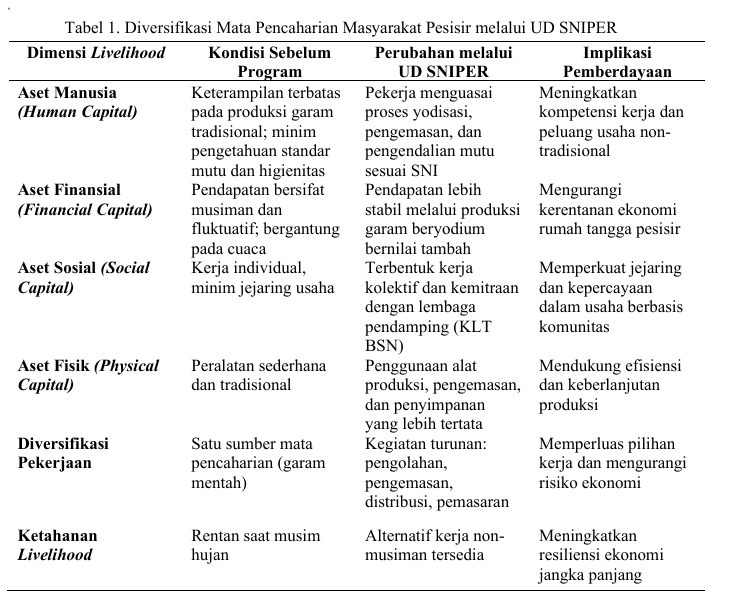
This study examines the role of UD SNIPER, a community-based micro-enterprise located in Pallengu Village, Bangkala District, Jeneponto Regency, in empowering coastal communities through iodized salt production. The research employed a qualitative descriptive approach within a community service framework to capture the dynamics of production activities and empowerment processes. Primary data were collected through in-depth interviews, direct observation, and participatory discussions involving business owners, workers, and local communities, while secondary data were obtained from institutional documents and relevant academic publications. The findings indicate that UD SNIPER produces approximately 250 kilograms of iodized salt per day and employs ten permanent local workers. The implementation of SNI ISO 3556:2016 has enhanced product quality, strengthened market competitiveness, and increased consumer trust. The enterprise generates direct impacts in the form of increased household income, job creation, and improved workforce skills, as well as indirect impacts including economic resilience, public health improvement through iodine deficiency prevention, and positive regional branding. Despite facing challenges related to seasonal raw material supply and market access, UD SNIPER demonstrates a viable model of coastal community empowerment based on local potential, standardization, and sustainable livelihood diversification, with significant implications for economic development, food security, and public health.
Downloads
Article Details
Section

This work is licensed under a Creative Commons Attribution-ShareAlike 4.0 International License.
How to Cite
References
[1] S. Windari and F. L. Nisa, “Potensi Wakaf Produktif Dalam Pemberdayaan Ekonomi Masyarakat di Indonesia,” Econ. Bus. Manag. Journal (EBMI), 2024, [Online]. Available: https://www.ejournal-rmg.org/index.php/EBMJ/article/view/215.
[2] A. Sulfianti, F. Husain, N. Hamid, and A. Amin, “Pendampingan Penerapan Standardisasi SNI 3556: 2016 Produk Garam Beryodium,” Journal of Pentahelix Adpertisi, vol. 1, no. 1, pp. 12–20, 2024. https://jurnal.adpertisi.or.id/index.php/JPA/article/view/521
[3] Nadimin, “Relationship between Level of Education and Use of Iodized Salt in South Sulawesi,” Mkmi, vol. 1, no. 1, pp. 235–240, 2015.
[4] Hayati and L. Savitri, “Kajian Fortifikasi Garam Beryodium Yang Beredar Di Kabupaten Siak Riau,” SITAWA J. Farm. Sains dan Obat Tradis., vol. 3, no. 1, pp. 75–88, 2024, https://doi.org/10.62018/sitawa.v3i1.90
[5] S. Irviani A. Ibrahim, Sitti Raodhah, Syarfaini, “Faktor-Faktor Yang Berhubungan Dengan Pemanfaatan Garam Beryodium Ibu Rumah Tangga di Kelurahan Pallengu Kabupaten Jeneponto,” Al-Sihah Public Heal. Sci. J., vol. 10, no. 1, pp. 26–36, 2018. https://repositori.uin-alauddin.ac.id/20695/
[6] N. Agustina and A. Ulilalbab, “Hubungan Merk Garam Dan Perilaku Penyimpanan Garam Dengan Kandungan Yodium Garam Rumah Tangga,” J. Kesehat. Tambusai, vol. 4, no. 1, pp. 191–198, 2023.
[7] S. Syabrinildi, “Pemberdayaan ekonomi masyarakat melalui kemitraan koperasi dan usaha mikro: sebuah studi pada sektor pertanian,” Innov. J. Soc. Sci. Res., 2024, [Online]. Available: http://j-innovative.org/index.php/Innovative/article/view/10334.
[8] D. Setiyawati, S. Semaun, and M. Muhammadun, “Implementasi Corporate Social Re Implementasi Corporate Social Responsibility PT. Angkasa Pura I Makassar Berbasis Pemberdayaan Ekonomi Masyarakat,” Ekalaya: J. Ekon. Akuntansi, 2023, [Online]. Available: https://jurnal.kalimasadagroup.com/index.php/ekalaya/article/view/93.
[9] D. Syafikri, D. Mardhia, F. Yahya, and N. Andriyani, “Pemberdayaan Kelompok Setia Kawan dalam Produksi Garam Beryodium di Desa Labuhan Bajo, Sumbawa,” Agrokreatif J. Ilm. Pengabdi. Kpd. Masy., vol. 6, no. 1, pp. 45–52, 2019, https://doi.org/10.29244/agrokreatif.6.1.45-52.
[10] M. Apriliana, “Produksi Pada Umkm Garam Beryodium Studi Kasus,” Indones. J. Econ. Law, vol. 1, no. 1, pp. 17–25, 2025. https://e-jurnal.jurnalcenter.com/index.php/ijel/article/view/887
[11] D. F. Az-zahra, A. Mone, and S. Sudarmi, “Pemberdayaan Masyarakat Pesisir Melalui Pemanfaatan Rumput Laut Di Kelurahan Pabiringa Kecamatan Binamu Kabupaten Jeneponto,” Kaji. Ilm. Mhs. Adm. Publik, vol. 4, no. 6, pp. 1227–1240, 2024, https://doi.org/10.26618/kimap.v4i6.13743.
[12] R. Sunoko, A. Saefuddin, R. Syarief, and N. Zulbainarni, “Proteksionisme dan Standardisasi Garam Konsumsi Beryodium,” J. Kebijak. Sos. Ekon. Kelaut. dan Perikan., vol. 12, no. 2, p. 101, 2022, https://doi.org/10.15578/jksekp.v12i2.11077.
[13] F. Azis, R. Risfaisal, and I. Rosa, “Modal Sosial Masyarakat Pesisir (Studi Kesejahteraan Sosial Petani Rumput Laut di Kabupaten Jeneponto),” Aksiologi J. Pendidik. dan Ilmu Sos., vol. 3, no. 1, pp. 24–36, 2022, https://doi.org/10.47134/aksiologi.v3i1.120.
[14] Z. Muhammad Chaerul, Yusmanizar, Abdul Samad A., “Pengembangan Garam Biasa Menjadi Garam Spa Sebagai Upaya Peningkatan Ketahanan Ekonomi Masyarakat Petani Garam Daerah Cikoang Kab . Takalar Development of Ordinary Salt into Spa Salt as an Effort to Increase the Economic Resilience of the Salt Farming Com,” Ekon. Ilmu Sos., vol. 1, no. 1, pp. 0–5, 2023. https://doi.org/10.35311/jmpm.v4i2.289
[15] Y. I. Jayadi, E. Elfira, N. Nurul, Wisda Sri Wahyuni, and F. Ramadan, “Penggunaan garam beryodium di Dusun Halahalaya, Desa Kanreapia, Kabupaten Gowa,” Soc. J. Public Heal. Serv., vol. 2, pp. 173–179, 2023, https://doi.org/10.24252/sociality.v2i2.40317.