
Digital-Based Civic Education Learning Strategies to Build Character and Strengthen Understanding of Pancasila Values
Article Sidebar
Main Article Content
Abstract
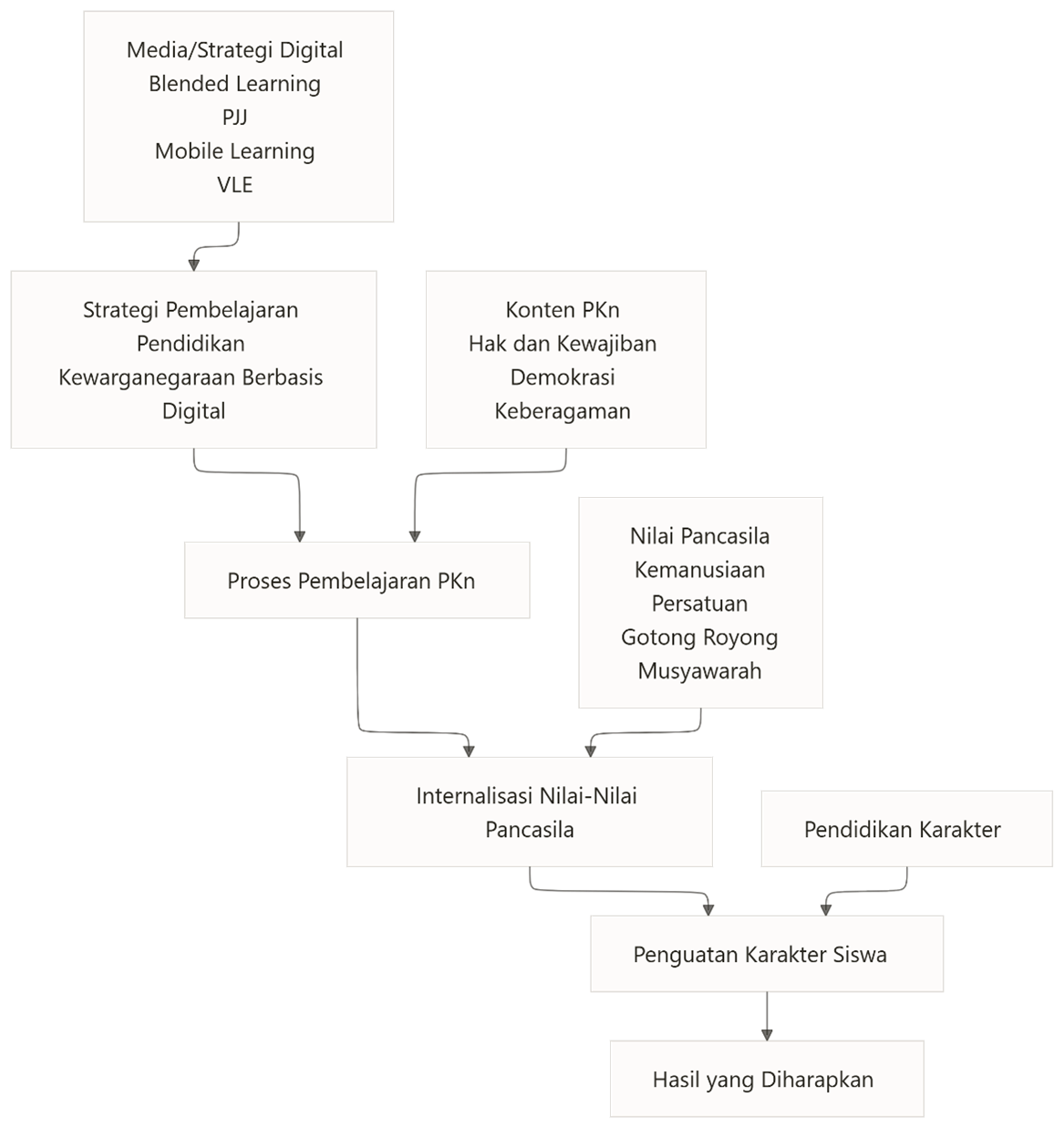
The foreword of this study highlights the changes in Civics learning in the digital era, which demands more adaptive strategies to shape students' character and strengthen their understanding of Pancasila values. The purpose of this study is to formulate a digital-based Civics learning strategy that can support the internalization of Pancasila values and strengthen students' character. The method used is a literature study with a descriptive qualitative approach through content analysis of books, journal articles, and relevant previous research results. Important research results indicate that models such as blended learning, distance learning, mobile learning, and virtual learning environments contribute to strengthening the values of deliberation, tolerance, independence, responsibility, democracy, and mutual cooperation. The implication is that digital-based Civics learning can be an effective strategy for developing students who are critical, adaptive, have character, and have the spirit of Pancasila in their daily lives.
Downloads
Article Details
Section

This work is licensed under a Creative Commons Attribution-ShareAlike 4.0 International License.
How to Cite
References
[1] P. B. Mawarsih, D. Soepardjo, W. Kurniawati, and R. Artikel, “Use of Co-Creation Media for Digital Natives in Ganesha Operation,” Paedagoria J. Study, Research. and Development. Education, vol. 15, no. 2, pp. 196–205, 2024, https://doi.org/10.31764/paedagoria.v15i2.21578
[2] R. R. Santoso and E. Soesanto, “Integration of Information Technology with Pancasila Values in the Era of Multiculturalism,” Socius J. Researcher. Social Sciences, vol. 27, no. 34, pp. 1–11, 2023, https://doi.org/10.5281/zenodo.11388129
[3] N. Juliper, HT Dandri, PWH Mita, WM Nissi, and T. Julinar, “Improving Student Literacy Through the Use of Technology in Learning to Increase Learning Interest in the Digital Era,” Journal of Human and Education, vol. 5, no. 2, pp. 243–249, 2025, https://doi.org/10.31004/jh.v5i2.2390
[4] S. A. Dewi and MF Azzajjad, “Learning Theory Conflict in Digital Native Students’ Learning Patterns,” J. SINORA, vol. 1, no. 1, pp. 31–37, 2025. https://journal.ajbnews.com/index.php/sinora/article/view/106
[5] M. P. Rizal and S. Nuraeni, “The Urgency of Strengthening Character Education in Educational Institutions for the Digital Native Generation,” in National Seminar on Education and Learning, 2023, pp. 1–17. https://doi.org/10.29407/rb4s0187
[6] E. Prasetiawati, “The urgency of multicultural education to foster the value of religious tolerance in Indonesia,” J. Research. Science., vol. 5, no. 2, pp. 273–303, 2017, doi: https://doi.org/10.32332/tapis.v1i02.876.
[7] I. Novianto and A. Pamungkas, “Communication between Lecturers and Students in the Digital- native Group in Higher Education,” AVANT GARDE, vol. 9, no. 1, pp. 79–99, 2021. https://doi.org/10.36080/ag.v9i1.1229
[8] Fatmawati, Hasniaty, and B. Syamsuddil, “Analysis of Resource Availability and Curriculum Development Processes to Industry Needs Mediated by Educational Quality at State Vocational High School 8 Samarinda, East Kalimantan Province,” J. Ekon. dan Manaj., vol. 6, no. 1, pp. 1–30, 2024, [Online]. Available: https://journalpedia.com/1/index.php/jem
[9] J. S. Mohammad and R. J. Indra, “Exploring Digital Literacy in Elementary School Learning,” J. Cahaya Edukasi, vol. 3, no. 1, pp. 35–39, 2025. https://doi.org/10.63863/jce.v3i1.17
[10] M. Abidin, “Moral Education and Its Relevance to Islamic Education,” Paris Lingkis, vol. 2, no. 1, pp. 57–66, 2021, https://doi.org/10.37304/paris.v2i1.3282.
[11] S. E. Susanti, “Character Education in Building Moral Intelligence for Early Childhood: Thomas Lickona’s Perspective,” TRILOGI J. Science Technol. Health, and Hum., vol. 3, no. 1, pp. 10–17, Apr. 2022, https://doi.org/10.33650/trilogi.v3i1.3396
[12] Z. Musthofa and FS Aqil, “Adaptive Storytelling Learning Strategy to Instill Noble Moral Values in MI Students in the Digital Era,” JIIP (Journal of Educational Sciences), vol. 8, no. 4, pp. 4282–4291, 2025, https://doi.org/10.54371/jiip.v8i4.7798
[13] N. S. Nurazizah and Supriyadi, “Innovation in Implementing the Independent Curriculum to Increase Student Creativity at the Bina Cipta Ujungberung Community Learning Center,” Rayah Al-Islam, vol. 8, no. 4, pp. 1658–1669, Nov. 2024, https://doi.org/10.37274/rais.v8i4.1115
[14] N. F. Naila and S. W. Indah, “21st Century Learning Media: Building an Adaptive Digital Generation,” J. Media Akad., vol. 2, no. 12, pp. 1–12, 2024, https://doi.org/10.62281/v2i12.1211
[15] B. U. Janah and N. Ristianah, “Application of the Blended Learning Method in Improving the Quality of Islamic Religious Education Learning,” Journal of Islamic Religious Education, vol. 2, no. 2, pp. 106–113, 2024, https://doi.org/10.56854/sasana.v2i2.318
[16] U. Heny, S. R. Rahmat, and A. S. Arico, “Flexibility and Adaptivity of the Blended Learning Approach,” Holist. Sci., vol. 1, no. 2, pp. 25–28, Nov. 2021, https://doi.org/10.56495/hs.v1i2.18
[17] L. Ambarwati and N. Trisnawati, “The Effectiveness of Distance Learning for Students in Correspondence Subjects,” J. Researcher. Educator Science., vol. 14, no. 2, pp. 158–170, 2021, https://doi.org/10.21831/jpipfip.v14i2.39564
[18] W. Bambang, “Mobile Learning as an Effective and Innovative Learning Model,” J. Teknodik, vol. XIV, no. 1, pp. 62–73, 2010, doi: https://doi.org/10.32550/teknodik.v14i1.452
[19] M. R. Cuhanazriansyah and H. Perta, “Technology-Based Learning Assessment Platform: Review of Forms and Challenges,” Journal of Educ. Res. Community Serv., vol. 1, no. 2, pp. 190–196, 2025. [Online]. Available: https://journal.nabaedukasi.com/index.php/jercs/article/view/26.
[20] M. Sofiroh, “21st Century Learning Transformation in Elementary Schools: Integration of Digital Literacy in the Independent Curriculum,” J. Educ. All(EduFA), vol. 3, no. 2, pp. 102–111, 2025, https://doi.org/10.61692/edufa.v3i2.314
[21] A. Rahwandira, “Transformation of Islamic Religious Values to Support Accessibility of Inclusive Education: A Socio-Educational Review,” Soc. Stud. Educ., vol. 02, no. 02, pp. 75–92, 2024, https://doi.org/10.15642/sse.2024.2.2.75-92
[22] F. A. W. Moh, M. Saufal, and Agustina, “Strategies for Using E-Learning Media to Improve Learning Outcomes,” J. Ilm. Penelit. Mhs., vol. 3, no. 1, pp. 529–540, 2025, https://doi.org/10.61722/jipm.v3i1.748
[23] M. Azka, N. N. Ziyan, R. Maulana, and A. Arleawati, “Citizenship Education as a Means of Internalizing Pancasila Values,” J. Educators and Indonesian Citizenship., vol. 2, no. 3, pp. 125–137, 2025. https://doi.org/10.61132/jupenkei.v2i3.704