
Pemanfaatan dan Pengelolaan Sampah Menuju Kabupaten Bantul Bebas Sampah
Bilah Samping Artikel
Isi Artikel Utama
Abstrak
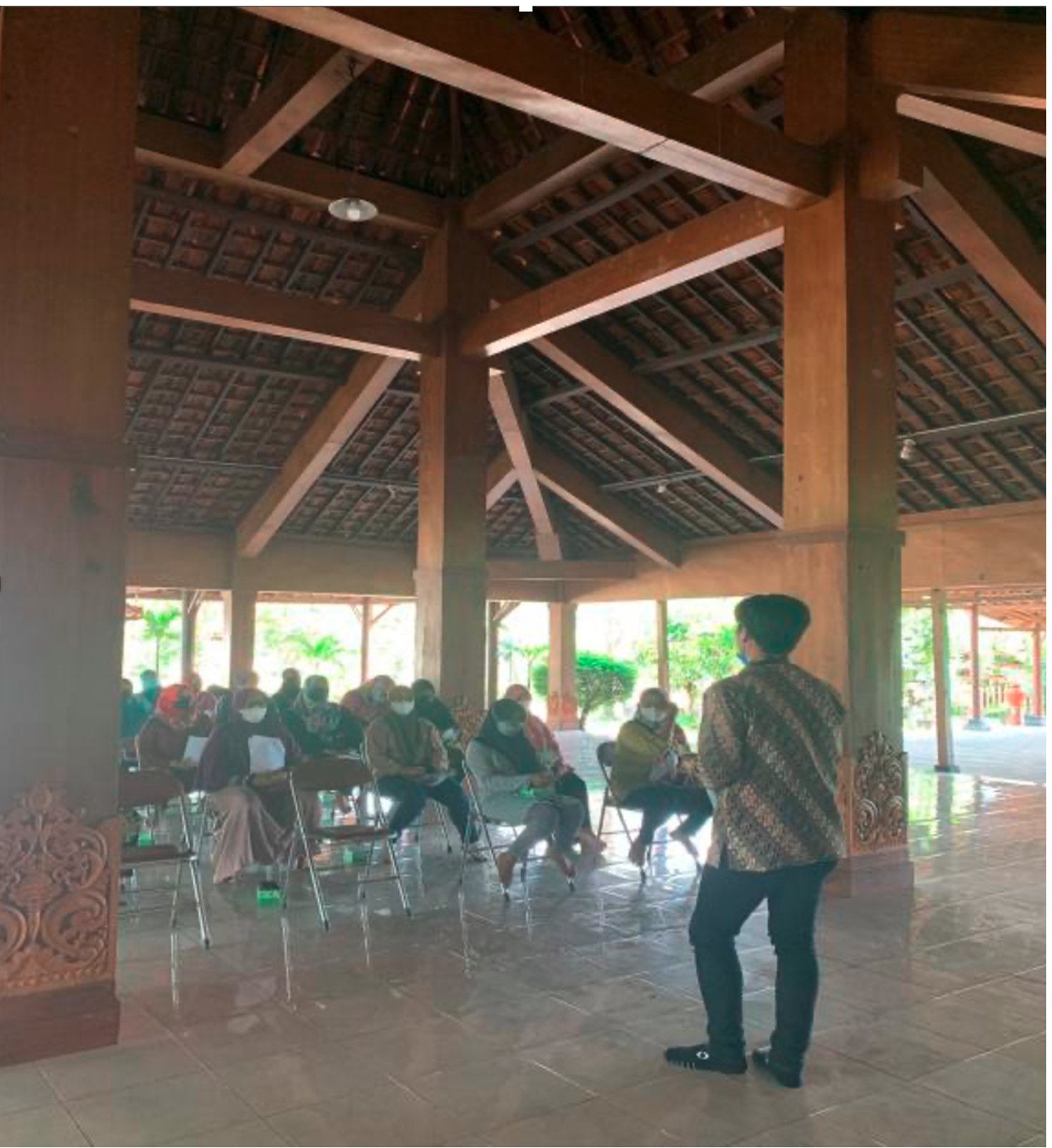
This community service activity was carried out in Pedukuhan Pedes, Argomulyo Village, Sedayu Subdistrict, Bantul, with the aim of increasing public awareness and knowledge regarding household waste management through the introduction of Ember Tumpuk (stacked composting buckets) and Ecobricks. The program was implemented in two main stages: field surveys and counseling sessions. The initial survey involved direct observation, coordination with the local head of Pedukuhan, and discussions with PKK women to identify community needs. Based on this assessment, a counseling program was designed and delivered in an offline setting, targeting PKK members as agents of change in waste management practices at the family level. A pre-test and post-test questionnaire was administered to measure the level of knowledge and practice. The results showed that before the counseling, 95.5% of participants had already heard of Ember Tumpuk, but only 4.5% had ever tried using it. Meanwhile, none of the participants had prior knowledge of Ecobricks. After the counseling session, 100% of participants reported understanding both concepts, with 92.3% expressing interest in practicing Ecobrick making. These findings highlight that targeted community service programs can significantly enhance knowledge, awareness, and motivation for sustainable household waste management, especially when mobilizing PKK groups as the main drivers of behavioral change
##plugins.themes.bootstrap3.displayStats.downloads##
Rincian Artikel
Terbitan
Bagian

Artikel ini berlisensiCreative Commons Attribution-ShareAlike 4.0 International License.
Cara Mengutip
Referensi
[1] R. Setyowati and S. A. Mulasari, “Pengetahuan dan Perilaku Ibu Rumah Tangga dalam Pengelolaan Sampah Plastik,” Kesmas: National Public Health Journal, vol. 7, no. 12, p. 562, 2013, doi: 10.21109/kesmas.v7i12.331.
[2] J. Said and Sungkono, “Pengolahan sampah plastik dan tanaman enceng gondok menjadi bahan bangunan alternatif hemat energi,” Jurnal Ilmiah, no. 1, pp. 187–192, 2016.
[3] D. Asteria and H. Heruman, “Bank Sampah As An Alternative of Community-Based Waste Management Strategy in Tasikmalaya,” Jurnal Manusia dan Lingkungan, vol. 23, no. 1, p. 136, 2016, doi: 10.22146/jml.18783.
[4] U. Linarti, A. Y. Astuti, and G. I. Budiarti, “Pengelolaan limbah minyak goreng bekas pakai di bank sampah Lintas Winongo, Kelurahan Bumijo, Kecamatan Jetis, Kota Yogyakarta,” Seminar Nasional Hasil Pengabdian Kepada Masyarakat Universitas Ahmad Dahlan, no. September, pp. 513–520, 2019.
[5] A. I. Almohana, M. Y. Abdulwahid, I. Galobardes, J. Mushtaq, and S. F. Almojil, “Producing sustainable concrete with plastic waste: A review,” Environmental Challenges, vol. 9, no. October, p. 100626, 2022, doi: 10.1016/j.envc.2022.100626.
[6] M. A. Fathurahman, O. Candra Dewi, and N. Nasruddin, “The Comparison of Energy Consumption from Clay, Inorganic-waste, and Light Brick as Wall Material,” MysuruCon 2022 - 2022 IEEE 2nd Mysore Sub Section International Conference, 2022, doi: 10.1109/MysuruCon55714.2022.9972735.
[7] G. S. Kumar and S. Sreerath, Development of Bricks Using Plastic Wastes, vol. 97. Springer International Publishing, 2021. doi: 10.1007/978-3-030-55115-5_32.
[8] S. Ko, Y. J. Kwon, J. U. Lee, and Y. P. Jeon, “Preparation of synthetic graphite from waste PET plastic,” Journal of Industrial and Engineering Chemistry, vol. 83, pp. 449–458, 2020, doi: 10.1016/j.jiec.2019.12.018.
[9] U. E. Edike, O. J. Ameh, and M. O. Dada, “Production and optimization of eco-bricks,” J Clean Prod, vol. 266, p. 121640, 2020, doi: 10.1016/j.jclepro.2020.121640.
[10] J. Taaffe, S. O’Sullivan, M. E. Rahman, and V. Pakrashi, “Experimental characterisation of Polyethylene Terephthalate (PET) bottle Eco-bricks,” Mater Des, vol. 60, pp. 50–56, 2014, doi: 10.1016/j.matdes.2014.03.045.