
Strengthening Environmental Awareness through Community Service Activities: A Collaboration of Waste Bank Programs, Children’s Education, and Greening Initiatives
Bilah Samping Artikel
Isi Artikel Utama
Abstrak
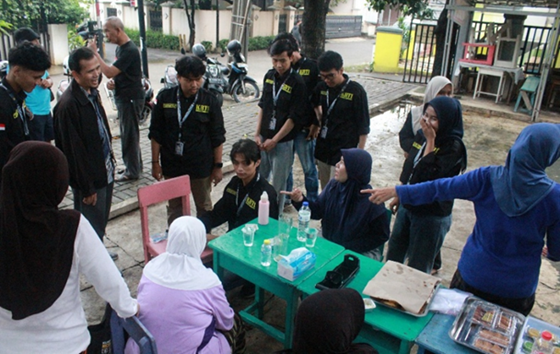
This community service program aims to strengthen environmental awareness through the collaboration of a waste bank, children’s environmental education, and a community greening initiative. The project was carried out by students participating in the Kuliah Kerja Nyata (KKN) program as part of the university’s commitment to community engagement. The activities included establishing and mentoring a community-based waste bank to manage recyclable waste, organizing creative games and drawing competitions to introduce environmental values to children, and planting fruit trees and herbal plants to create a greener neighborhood. The results indicate an increase in residents’ participation in waste sorting, better understanding of the economic value of recyclable materials, and growing environmental concern among children. The greening program also fostered a sense of togetherness and improved the aesthetic quality of the area. The integration of these three initiatives proved effective in promoting lasting ecological awareness and community responsibility. This program provides a practical model for sustainable community empowerment that can be adapted in other regions. Overall, the KKN environmental project demonstrates the important role of students as facilitators in linking academic knowledge with real community action toward sustainable development.
##plugins.themes.bootstrap3.displayStats.downloads##
Rincian Artikel
Terbitan
Bagian

Artikel ini berlisensiCreative Commons Attribution-ShareAlike 4.0 International License.
Cara Mengutip
Referensi
[1] P. C. Taraya and A. P. Wibawa, “Mewujudkan Society 5.0 Melalui Pemanfaatan Teknologi Kecerdasan Buatan,” J. Inov. Tek. dan Edukasi Teknol., vol. 2, no. 8, 2022. https://doi.org/10.17977/um068v2i82022p378-385
[2] A. Lis, “Energy Security in National Security Strategies: A Multiple Case Study,” Barom. Reg. Anal. i Prognozy, vol. 19, no. 2, 2023. https://doi.org/10.56583/br.2280
[3] E. Sayed, A. Ahmed, and M. E. Yousef, “Internet of things in Smart Environment: Concept, Applications, Challenges, and Future Directions Article Contents,” World Sci. News An Int. Sci. J., vol. WSN 134 (1), 2019.
[4] Q. Zuo, “National multi-level guarantee system for the water ecological health,” Shuili Xuebao/Journal Hydraul. Eng., vol. 52, no. 11, pp. 1347–1354, 2021.
[5] A. Siddiqua, J. N. Hahladakis, and W. A. K. A. Al-Attiya, “An overview of the environmental pollution and health effects associated with waste landfilling and open dumping,” Environmental Science and Pollution Research, vol. 29, no. 39. 2022. https://doi.org/10.1007/s11356-022-21578-z
[6] S. Suhairi, N. H. Panjaitan, L. A. Lubis, and D. R. Amwa, “Pengaruh Lingkungan Pemasaran Global terhadap Perekonomian di Indonesia,” J. Educ., vol. 5, no. 3, 2023. https://doi.org/10.31004/joe.v5i3.1728
[7] C. Kerdpitak, W. Mekkham, and L. Girdwichai, “Effective waste management as a predictor of competitive advantage: Mediating role of green purchasing and logistics,” Int. J. Supply Chain Manag., vol. 8, no. 5, pp. 830–841, 2019. https://doi.org/10.59160/ijscm.v8i5.3675
[8] Y. A. Hidayat, S. Kiranamahsa, and M. A. Zamal, “A study of plastic waste management effectiveness in Indonesia industries,” AIMS Energy, vol. 7, no. 3, 2019. https://doi.org/10.3934/energy.2019.3.350
[9] C. Y. Manullang, M. P. Patria, A. Haryono, S. T. Anuar, S. Suyadi, and R. D. A. Opier, “Status and Research Gaps of Microplastics Pollution in Indonesian Waters: A Review,” Indonesian Journal of Chemistry, vol. 23, no. 1. 2023. https://doi.org/10.22146/ijc.73485
[10] A. M. S. Asih, F. Trapsilawati, B. M. Sopha, and N. M. E. Normasari, “Waste Bank Program for Households as A Means of Processing Inorganic Waste,” J. Pengabdi. Kpd. Masy. (Indonesian J. Community Engag., vol. 8, no. 4, 2022. https://doi.org/10.22146/jpkm.73409
[11] R. Purwandari, D. Daniel, and F. Hafidz, “Analysis of water, sanitation, and hygiene facilities using the WASH-FIT approach and its relation to patient satisfaction and maternal mortality at hospitals in Indonesia,” Front. Public Heal., vol. 12, 2024. https://doi.org/10.3389/fpubh.2024.1322470
[12] M. Mehrabioun, “A multi-theoretical view on social media continuance intention: Combining theory of planned behavior, expectation-confirmation model and consumption values,” Digit. Bus., vol. 4, no. 1, 2024. https://doi.org/10.1016/j.digbus.2023.100070
[13] D. A. E. van Aalst, G. Huitsing, and R. Veenstra, “Understanding Teachers’ Likelihood of Intervention in Bullying Situations: Testing the Theory of Planned Behavior,” Int. J. Bullying Prev., 2024. https://doi.org/10.1007/s42380-024-00209-w
[14] I. A. Udoh and B. Willard, “Community-Based Social Marketing: A Supplemental Approach to Improve Environmental Attitudes and Environmental Health in Nigeria,” Environ. Commun., vol. 17, no. 2, 2023. https://doi.org/10.1080/17524032.2023.2175005
[15] N. Vantamay, “‘3S project’: A community-based social marketing campaign for promoting sustainable consumption behavior among youth,” J. Komun. Malaysian J. Commun., vol. 35, no. 4, 2019. https://doi.org/10.17576/JKMJC-2019-3504-03
[16] D. Streimikiene, “Community based social marketing for greenhouse gas emission reduction in households,” Manag. Mark., vol. 17, no. 4, 2022. https://doi.org/10.2478/mmcks-2022-0027
[17] S. Komonkanjanakul and R. Supapongpichate, “A model of participatory learning process for management of environmental health impacts in industrial communities area,” J. Heal. Res., vol. 36, no. 6, 2022. https://doi.org/10.1108/JHR-07-2020-0277
[18] C. D. Trott, A. E. Weinberg, S. M. Frame, P. Jean-Pierre, and T. L. Even, “Civic science education for youth-driven water security: A behavioral development approach to strengthening climate resilience,” Int. J. Behav. Dev., vol. 48, no. 2, 2024. https://doi.org/10.1177/01650254231188661
[19] H. Baohua, Y. Rongzhen, L. Jie, and Z. Qiao, “Practice and exploration of participatory environmental education in colleges and universities,” Chinese Educ. Soc., vol. 43, no. 2, 2010. https://doi.org/10.2753/CED1061-1932430209
[20] I. Ahmad, “Evaluation of the Implementation of Waste Bank Activities,” J. Ilmu Lingkung., vol. 20, no. 2, 2022. https://doi.org/10.14710/jil.20.2.414-426
[21] S. Collado, C. D. Rosa, and J. A. Corraliza, “The effect of a nature-based environmental education program on children’s environmental attitudes and behaviors: A randomized experiment with primary schools,” Sustain., vol. 12, no. 17, 2020. https://doi.org/10.3390/su12176817
[22] M.-J. Joe and S.-H. Kim, “The Composition and Effects of a Young Children’s Environmental Education Program connecting to Family,” Korea Assoc. Early Child. Educ. Educ. Welf., vol. 27, no. 2, 2023. https://doi.org/10.1080/00958960309603483
[23] L. Y. Alexandrova, O. F. Kireeva, E. V Krasilnikova, A. Y. Munshi, and S. V Timofeev, “Approaches to solving the existing problems in green logistics,” in Studies in Systems, Decision and Control, vol. 316, Cheboksary Cooperative Institute (Branch) of the Russian University of Cooperation, Cheboksary, Russian Federation: Springer Science and Business Media Deutschland GmbH, 2021, pp. 857–868. https://doi.org/10.1007/978-3-030-57831-2_92
[24] R. Muhendra, A. Jatmiko, and Y. Reviyanti, “Pendampingan dan Pengembangan Sistem Pengolahan Sampah serta Perancangan Produk Pupuk Cair Bernilai Market sebagai Produk Inovasi di Kelurahan Perwira Kota Bekasi Jawa Barat,” J. Sains Teknol. dalam Pemberdaya. Masy., vol. 3, no. 1, 2022. https://doi.org/10.31599/65q68w44
[25] R. Malli, “Landasan Ontologi Ilmu Pengetahuan,” TARBAWI J. Pendidik. Agama Islam, vol. 4, no. 01, 2019. https://doi.org/10.26618/jtw.v4i01.2133
[26] J. Moore, P. Goffin, J. Wiese, and M. Meyer, “An interview method for engaging personal data,” Proc. ACM Interactive, Mobile, Wearable Ubiquitous Technol., vol. 5, no. 4, 2021. https://doi.org/10.1145/3494964
[27] D. van de Bongardt and M. Verbeek, “New Interview Method for Sketching the Dynamic Relational and Sexual History of Young Adults,” Sex. Res. Soc. Policy, vol. 18, no. 4, 2021. https://doi.org/10.1007/s13178-020-00514-1
[28] C. Von Soest, “Why Do We Speak to Experts? Reviving the Strength of the Expert Interview Method,” Perspect. Polit., vol. 21, no. 1, 2023. https://doi.org/10.1017/S1537592722001116
[29] B. DiCicco-Bloom and B. F. Crabtree, “The qualitative research interview,” Medical Education, vol. 40, no. 4. 2006. https://doi.org/10.1111/j.1365-2929.2006.02418.x