
Socialization of Liquid Soap Preparation from Lime Peel Extract for Health Improvement in Jarum Village
Bilah Samping Artikel
Isi Artikel Utama
Abstrak
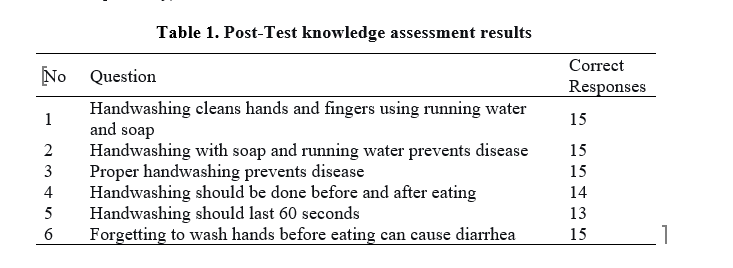
Hand hygiene is a critical component in preventing disease transmission, particularly in community settings. This community service initiative aimed to enhance public knowledge and practices regarding proper handwashing techniques using antibacterial liquid soap formulated with lime peel essential oil extract. The program combined theoretical education on the antibacterial properties of lime peel extract with practical demonstrations of correct handwashing procedures. Methods included pre- and post-test evaluations to measure knowledge improvement, alongside hands-on training in proper handwashing techniques. Results demonstrated significant improvement in participants' understanding, with 100% correct answers on key questions regarding hand hygiene importance and techniques. The initiative concluded that integrative health education effectively promotes community health awareness and proper hygiene practices, recommending expanded outreach to other regions.
##plugins.themes.bootstrap3.displayStats.downloads##
Rincian Artikel
Terbitan
Bagian

Artikel ini berlisensiCreative Commons Attribution-ShareAlike 4.0 International License.
Cara Mengutip
Referensi
[1] U. Zein and E. El Newi, “Buku ajar ilmu kesehatan (memahami gejala, tanda dan mitos).” Deepublish, 2019.
[2] W. H. Organisation, “WHO guidelines on hand hygiene in health care,” WHO/IER/PSP. World Health Org anisation Geneva, 2009.
[3] R. I. Permenkes, “Undang-undang No. 36 Tahun 2009 tentang Kesehatan.” Jakarta, 2009.
[4] R. I. S. Negara, “Undang-Undang No. 36 Tahun 2009 tentang Kesehatan,” Jakarta: Sekretariat Negara Republik Indonesia. 2009.
[5] A. S. S. Putri, A. S. Noorhamdani, and K. D. Novita, “Uji In Vitro Antibakteri Minyak Atsiri Kulit Jeruk Nipis (Citrus aurantifolia) Dalam Menghambat Pertumbuhan Bakteri Streptococcus agalactiae,” Maj. Kesehat., 2021, [Online]. Available: https://majalahfk.ub.ac.id/index.php/mkfkub/article/view/454.
[6] N. J. K. AS, Uji Aktivitas Antibakteri Ekstrak Metanol Daun Mimba (Azadirachta Indica A. Juss.) Terhadap Bakteri Bacillus subtilis. repository.akfarsurabaya.ac.id, 2024.
[7] D. F. Lestari, F. Fatimatuzzahra, and D. Dwi, “Uji Daya Hambat Bakteri Staphylococcus Aureus Sabun Cuci Tangan Cair Berbahan Arang Aktif Batok Kelapa,” J. Sains Dan Kesehatan, 2021, [Online]. Available: http://jsk.ff.unmul.ac.id/index.php/JSK/article/view/321.
[8] M. K. Swamy, M. S. Akhtar, and U. R. Sinniah, “Antimicrobial properties of plant essential oils against human pathogens and their mode of action: an updated review,” Evidence-Based Complement and Alternative Medicine, 2016, https://doi.org/10.1155/2016/3012462
[9] V. Curtis and S. Cairncross, “Effect of washing hands with soap on diarrhoea risk in the community: a systematic review,” Lancet Infect. Dis., 2003, [Online]. Available: https://www.thelancet.com/journals/laninf/article/PIIS1473309903006066/abstract.
[10] L. Rosen, D. Zucker, D. Brody, and A. M. Meir, “The effect of a handwashing intervention on preschool educator beliefs, attitudes, knowledge and self-efficacy,” Heal. Educ. Research, 2009, https://doi.org/10.1093/her/cyp004
[11] A. K. Das, M. N. Islam, M. O. Faruk, and M. Ashaduzzaman, “Review on tannins: Extraction processes, applications and possibilities,” South African Journal of Botany. 2020, https://doi.org/10.1016/j.sajb.2020.08.008
[12] M. Chitkara, R. K. Sindhu, I. Singh, and D. Kumar, “Formulation and evaluation of essential oils based liquid herbal hand wash,” Research Joirnal of Pharm. and Technology, 2020, https://doi.org/10.5958/0974-360X.2020.00345.5
[13] B. H. Aboul-Enein, P. J. Kelly, S. Raddi, and T. Keller, “Effectiveness of hand hygiene campaigns and interventions across the League of Arab States: a region-wide scoping review,” J. Hosp. Infection, 2024, https://doi.org/10.1016/j.jhin.2024.02.022
[14] R. Savant, R. J. Singh, S. C. Hazarika, and T. Majumdar, “Knowledge, attitude, and practice towards food safety amongst school children, food handlers and consumers: protocol for a pre-post longitudinal study in North East India,” Frontiers in public Health. frontiersin.org, 2025, https://doi.org/10.3389/fpubh.2025.1643443
[15] R. Aunger and V. Curtis, “Behaviour Centred Design: towards an applied science of behaviour change,” Health Psychol. Rev., 2016, https://doi.org/10.1080/17437199.2016.1219673
[16] W. P. Schmidt, R. Aunger, Y. Coombes, and P. M. Maina, “Determinants of handwashing practices in Kenya: the role of media exposure, poverty and infrastructure,” Trop. Med. & International Health, 2009, https://doi.org/10.1111/j.1365-3156.2009.02404.x