
Analisis Ergonomi Berbasis Biomekanika dan Fisiologi pada Manual Material Handling dalam Rangka Optimalisasi Kesehatan dan Keselamatan Kerja Berkelanjutan
Article Sidebar
Main Article Content
Abstract
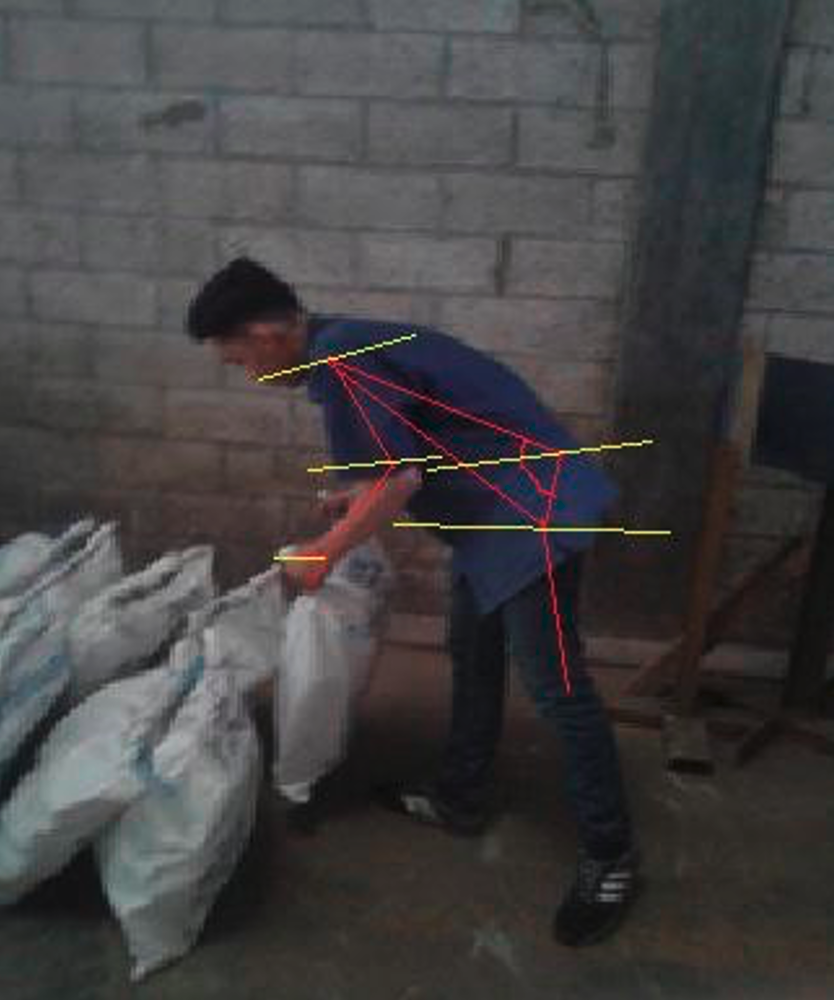
This study analyzes ergonomic aspects of Manual Material Handling (MMH) based on biomechanical and physiological approaches to optimize sustainable occupational health and safety. The research aims to identify factors influencing musculoskeletal complaints, determine load characteristics, and assess the feasibility of alternative work system improvements. The method involves direct observation of MMH activities during the lifting of iron sacks, followed by biomechanical and physiological assessments. Biomechanical analysis was conducted by calculating the compression load on the intervertebral disc between lumbar 5 and sacrum 1 (L5/S1) and comparing the results with the National Institute for Occupational Safety and Health (NIOSH) standards for Maximum Permissible Limit (MPL). The findings show that lifting a 35 kg load generates a compression force of 12,361 N at L5/S1, which exceeds both the MPL of 6,500 N and the Action Limit of 3,500 N, indicating that the activity is classified as hazardous. As an improvement, the implementation of a trolley tool significantly reduced the compression force to 650.58 N, far below the MPL threshold. This result highlights that redesigning the work system through ergonomic interventions can effectively minimize spinal injury risks and support sustainable occupational health and safety practices
Downloads
Article Details
Section

This work is licensed under a Creative Commons Attribution-ShareAlike 4.0 International License.
How to Cite
References
[1] J. Bartnicka, “Knowledge-based ergonomic assessment of working conditions in surgical ward - A case study,” Saf Sci, vol. 71, no. PB, pp. 178–188, 2015, doi: 10.1016/j.ssci.2014.08.010.
[2] M. Khalidy, R. Zakaria, and P. Ariscasari, “Analisis risiko Ergonomis dan keluhan kesehatan pekerja produksi rokok PT Rampago Jaya Sukamakmur Aceh Besar tahun 2024,” Jurnal Kesehatan Tambusai, vol. 5, no. 4, pp. 11660–11669, 2024.
[3] R. Laili, “Ergonomi sebagai Upaya Pencegahan Gangguan Musculoskeletal pada Perawat,” Browne, p. 3, 2020.
[4] C. S. Moriguchi et al., “Impact of experience when using the Rapid Upper Limb Assessment to assess postural risk in children using information and communication technologies,” Int J Ind Ergon, vol. 70, no. December 2018, pp. 398–405, 2019, doi: 10.1016/j.apergo.2013.05.004.
[5] M. Rajendran, A. Sajeev, R. Shanmugavel, and T. Rajpradeesh, “Ergonomic evaluation of workers during manual material handling,” Mater Today Proc, vol. 46, pp. 7770–7776, 2021, doi: 10.1016/j.matpr.2021.02.283.
[6] D. R. Jones, “The Relationship Between Working Conditions and Musculoskeletal/Ergonomic Disorders in a Manufacturing Facility – A Longitudinal Research Study,” Procedia Manuf, vol. 3, no. Ahfe, pp. 4480–4484, 2015, doi: 10.1016/j.promfg.2015.07.461.
[7] F. C. Trevelyan, “Musculoskeletal disorders in a handmade brick manufacturing plant,” Int J Ind Ergon, vol. 27, no. 1, pp. 43–55, 2001, doi: 10.1016/S0169-8141(00)00036-6.
[8] M. Rasoulivalajoozi, M. Rasouli, C. Cucuzzella, and T. H. Kwok, “Prevalence of musculoskeletal disorders and postural analysis of beekeepers,” Int J Ind Ergon, vol. 98, no. July, p. 103504, 2023, doi: 10.1016/j.ergon.2023.103504.
[9] D. Dane, M. Feuerstein, G. D. Huang, L. Dimberg, D. Ali, and A. Lincoln, “Measurement properties of a self-report index of ergonomic exposures for use in an office work environment,” J Occup Environ Med, vol. 44, no. 1, pp. 73–81, 2002, doi: 10.1097/00043764-200201000-00012.
[10] U. Karukunchit, R. Puntumetakul, M. Swangnetr, and R. Boucaut, “Prevalence and risk factor analysis of lower extremity abnormal alignment characteristics among rice farmers,” Patient Prefer Adherence, vol. 9, pp. 785–795, 2015, doi: 10.2147/PPA.S81898.
[11] S. Vinberg, “Occupational safety and health challenges in small-scale enterprises,” Ind Health, vol. 58, no. 4, pp. 303–305, 2020, doi: 10.2486/indhealth.58_400.
[12] M. Siska and M. Teza, “Analisa Posisi Kerja pada Proses Pencetakan Batu Bata Menggunakan Metode NIOSH,” Jurnal Ilmiah Teknik Industri, vol. 11, no. 1, pp. 61–70, 2012.
[13] J. Chin, Herlina, H. Iridiastadi, L. Shu-Chiang, and S. Fadil Persada, “Workload Analysis by Using Nordic Body Map, Borg RPE and NIOSH Manual Lifting Equation Analyses: A Case Study in Sheet Metal Industry,” J Phys Conf Ser, vol. 1424, no. 1, pp. 4–10, 2019, doi: 10.1088/1742-6596/1424/1/012047.