
Enhancing Vocational Students’ Understanding of Energy Sector Developments through Industry-Based Training on Oil and Gas
Article Sidebar
Main Article Content
Abstract
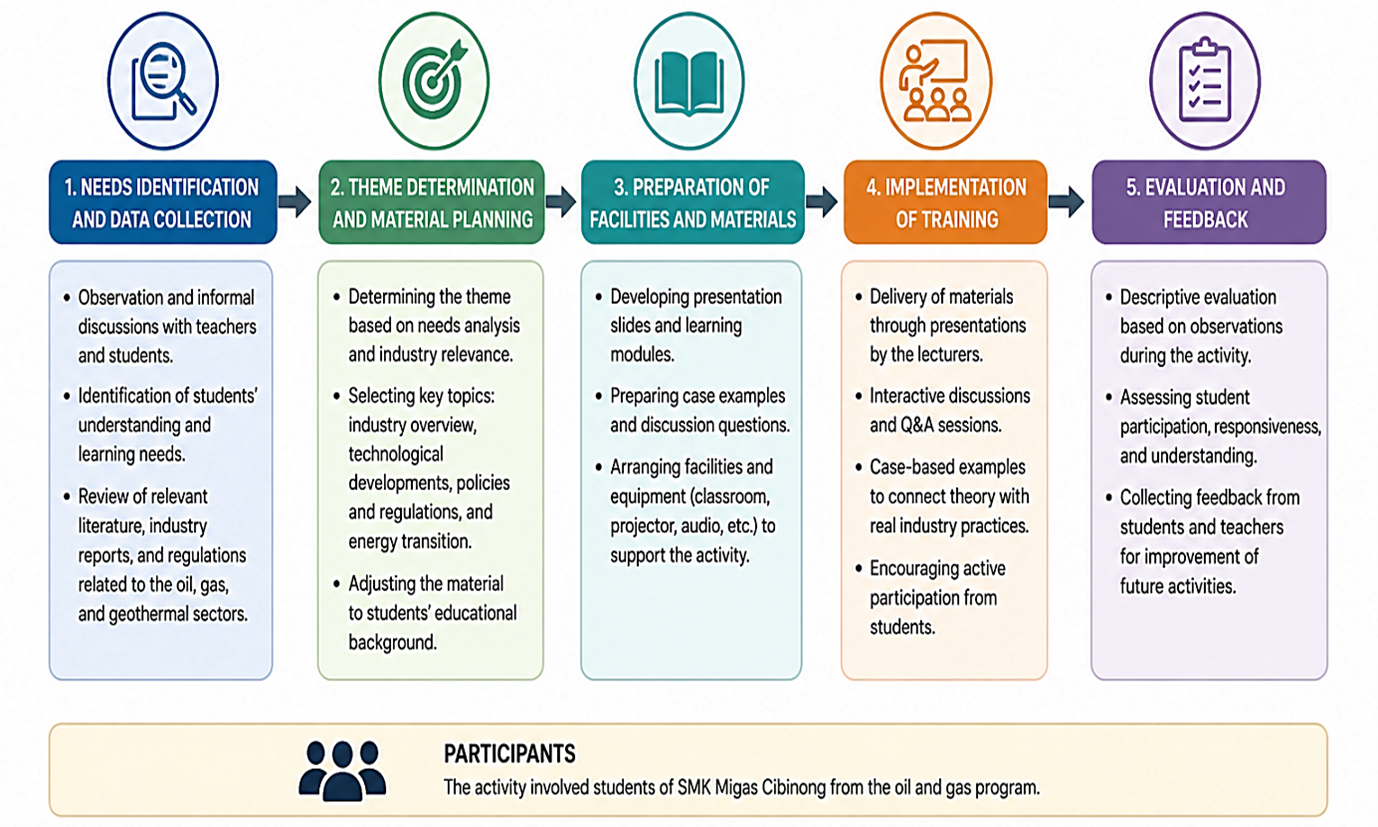
This study reports a community service activity aimed at enhancing vocational students’ understanding of current developments in the energy sector, particularly in oil and gas, geothermal energy, and energy transition. The activity was conducted at SMK Migas Cibinong and involved 20 students from Grades 11 and 12 of the Oil and Gas Program. The training was implemented through an industry-based learning approach that combined material presentations, industrial case examples, contextual explanations, and interactive discussions. The training materials covered recent developments in the oil and gas industry, geothermal energy utilization, and the role of both sectors in supporting energy transition. Evaluation was conducted through participant observation and a post-training questionnaire assessing material relevance, perceived knowledge improvement, and training usefulness. The results showed positive participant responses, with mean scores of 4.8 for material relevance, 4.6 for perceived knowledge improvement, and 4.9 for training usefulness. Students also demonstrated active participation and increased interest in current energy-sector issues, particularly when industrial case examples were introduced. These findings indicate that industry-based learning activities have the potential to broaden students’ perspectives, strengthen the connection between theoretical knowledge and industrial practice, and support vocational education in responding to evolving workforce demands.
Downloads
Article Details
Section

This work is licensed under a Creative Commons Attribution-ShareAlike 4.0 International License.
How to Cite
References
[1] D. U. Laksmana and U. Wikarya, “The role of natural gas in indonesia co2 mitigation action: The environmental kuznets curve framework,” Int. J. Adv. Sci. Eng. Inf. Technol., no. 1, 2020, https://doi.org/10.18517/ijaseit.10.1.10660
[2] A. Bagaskara, “Indonesia Energy Transition Outlook 2023: Tracking Progress of Energy Transition in Indonesia: Pursuing Energy Security in the Time of Transition,” Inst. Essent. Serv. Reform, 2023.
[3] A. P. Muyasyaroh, “Rethinking Energy Security in Indonesia from a Net Zero Perspective,” Indones. J. Energy, vol. 7, no. 1, 2024, https://doi.org/10.33116/ije.v7i1.197
[4] N. A. Hamid, F. M. Kamaruzaman, and M. S. Rasul, “Concept of circular economy in technical and vocational education: a systematic literature review,” Int. J. Eval. Res. Educ. , vol. 13, no. 4, 2024, https://doi.org/10.11591/ijere.v13i4.28125
[5] M. Lupikawaty, L. Novianti, A. S. Handayani, and M. A. Rakhman, “Competency Mapping of Vocational Education Graduates of South Sumatra Province Based on Leading Industries Using Input-Output Analysis,” Enrich. J. Multidiscip. Res. Dev., vol. 3, no. 2, 2025, https://doi.org/10.55324/enrichment.v3i2.369
[6] N. A. Pambudi and D. K. Ulfa, “The geothermal energy landscape in Indonesia: A comprehensive 2023 update on power generation, policies, risks, phase and the role of education,” Renewable and Sustainable Energy Reviews, vol. 189. 2024, https://doi.org/10.1016/j.rser.2023.114008
[7] P. Boschee, “Comments: Energy Transition and Labor Transition,” J. Pet. Technol., vol. 75, no. 02, 2023, https://doi.org/10.2118/0223-0008-jpt
[8] N. I. Arilaha, “Bridging the Skill Gap in Energy Transition: Towards a Sustainable Workforce Development,” KnE Soc. Sci., vol. 10, no. 23, 2025, https://doi.org/10.18502/kss.v10i23.19756
[9] C. O. Okuh, E. O. Nwulu, E. Ogu, P. I. Egbumokei, I. N. Dienagha, and W. N. Digitemie, “Creating a Workforce Upskilling Model to Address Emerging Technologies in Energy and Oil and Gas Industries,” Int. J. Multidiscip. Res. Growth Eval., vol. 5, no. 1, 2024, https://doi.org/10.54660/.ijmrge.2024.5.1.1327-1339
[10] G. U. Ikenga and P. van der Sijde, “Twenty-First Century Competencies; about Competencies for Industry 5.0 and the Opportunities for Emerging Economies,” Sustainability (Switzerland), vol. 16, no. 16. 2024, https://doi.org/10.3390/su16167166
[11] P. S. Perumal and K. Manoharan, “Analysis of Industry based Experiential Learning for Undergraduate courses in Civil Engineering,” J. Eng. Educ. Transform., vol. 36, no. Special Issue 1, 2022, https://doi.org/10.16920/jeet/2022/v36is1/22179.
[12] F. Handayani Hanim, Rufi’i, and Harwanto, “Effect Of Industry-Based Learning And Motivation On Stu- Dent’s Entrepreneurship Competencies,” Edutech, vol. 1, no. 1, 2020. https://doi.org/10.17509/e.v1i1.20876
[13] N. Phuthi and L. Mpofu, “The Quality of Supervision and Assessment in Industry-Based Learning,” Int. J. Soc. Learn., vol. 2, no. 1, 2021, https://doi.org/10.47134/ijsl.v2i1.98
[14] D. H. Karwan, H. Hariri, and R. Ridwan, “Partnership Management in Industry-Based Learning in Vocational Secondary Schools of Lampung Province,” J. Manaj. Mutu Pendidik., vol. 8, no. 2, 2020. https://jurnal.fkip.unila.ac.id/index.php/JMMP/article/view/21051
[15] W. Budhtranon, C. Chianchana, and S. Kamkhuntod, “Developing a Conceptual Framework of Instructional Model for Creating an Innovative Business Project: Applying the Sufficiency Economy Philosophy for Private Vocational Colleges in Bangkok, Thailand,” J. Tech. Educ. Train., vol. 13, no. 4, pp. 15–27, 2021, https://doi.org/10.30880/jtet.2021.13.04.002
[16] S. Suwarno, W. Wahidin, and S. H. Nur, “Project-based learning model assisted by worksheet: It’s effect on students’ creativity and learning outcomes,” JPBI (Jurnal Pendidik. Biol. Indones., vol. 6, no. 1, 2020, https://doi.org/10.22219/jpbi.v6i1.10619
[17] E. P. R. Dafana, R. P. Dinarti, and M. Yasin, “Menganalisis Potret Industri Indonesia Berdasarkan Industri Pengolahan Migas dan Non-Migas,” Trending J. Manaj. dan Ekon., vol. 2, no. 3, 2024, https://doi.org/10.30640/trending.v2i3.2675
[18] A. A. Popov, “Legal Aspects and New Trends in The Development of The Oil and Gas Industry in Indonesia,” Mezhdunarodnaja jekonomika (The World Econ., no. 11, 2025, https://doi.org/10.33920/vne-04-2511-03
[19] S. A. Salsabila, M. P. Maharani, and A. P. Joestiawan, “Solar Enhanced Oil Recovery as the Solution to Enhance Oil and Gas Production for Mature Fields in Indonesia,” Indones. J. Energy, vol. 6, no. 2, 2023, https://doi.org/10.33116/ije.v6i2.163
[20] S. W. Yudha, B. Tjahjono, and P. Longhurst, “Unearthing the Dynamics of Indonesia’s Geothermal Energy Development,” Energies, vol. 15, no. 14, 2022, https://doi.org/10.3390/en15145009
[21] H. Setiawan, “Geothermal Energy Development in Indonesia: Progress, Challenges and Prospect,” Int. J. Adv. Sci. Eng. Inf. Technol., vol. 4, no. 4, 2014, https://doi.org/10.18517/ijaseit.4.4.405
[22] G. M. Idroes, S. Syahnur, M. S. A. Majid, R. Idroes, F. Kusumo, and I. Hardi, “Unveiling the Carbon Footprint: Biomass vs. Geothermal Energy in Indonesia,” Ekon. J. Econ., vol. 1, no. 1, 2023, https://doi.org/10.60084/eje.v1i1.47
[23] R. Dias, M. Chambino, and P. Alexandre, “Strength in Transition: Resilience of Sustainable Energy vs. Fossil Energy,” 2023, https://doi.org/10.31410/itema.2023.157
[24] A. C. Adamuthe and M. A. Patil, “Roadmap to inculcate complex problem-solving skills in cs/it students,” J. Eng. Educ. Transform., vol. 34, no. 2, pp. 61–74, 2020, https://doi.org/10.16920/jeet/2020/v34i2/149313
[25] C. Gupta, “The Impact and Measurement of Today’s Learning Technologies in Teaching Software Engineering Course Using Design-Based Learning and Project-Based Learning,” IEEE Trans. Educ., vol. 65, no. 4, pp. 703–712, 2022, https://doi.org/10.1109/TE.2022.3169532
[26] A. Khelil and A. L. Ben Hassine, “Impact of knowledge management system and organisational learning on employees’ competence in banks,” Int. J. Process Manag. Benchmarking, vol. 17, no. 4, 2024, https://doi.org/10.1504/IJPMB.2024.140029