
Analysis of MSME Actors' Experience in Digital Financial Literacy Mentoring of the MANTAP MSME Program in Malang City
Article Sidebar
Main Article Content
Abstract
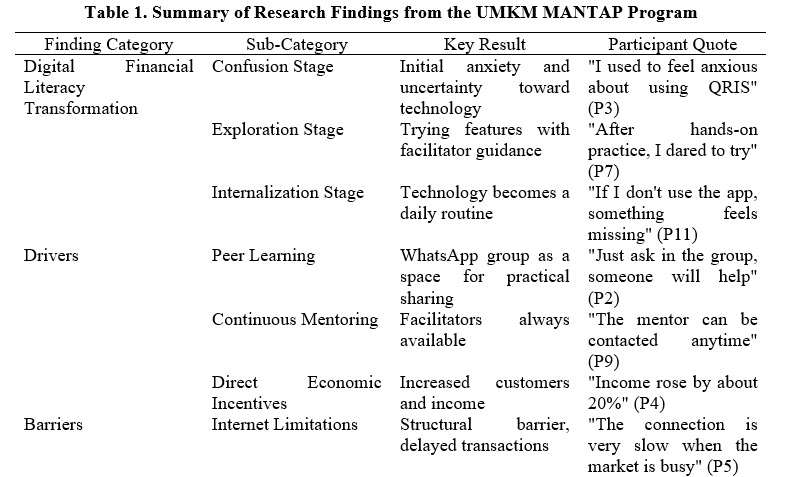
This study aims to explore the experiences of micro and small business owners in Malang City who participated in the UMKM MANTAP digital financial literacy mentoring program, focusing on the transformation process, adoption barriers, and the meanings participants constructed from the program. A qualitative phenomenological approach was employed, involving 15 participants who had completed at least 75% of the program sessions and actively implemented digital financial practices in their businesses. Data were collected through in-depth semi-structured interviews, participatory observation, and document review, and were subsequently analyzed using phenomenological thematic analysis. The findings identified three main themes: (1) digital financial literacy transformation, which occurred gradually through the stages of confusion, exploration, and internalization; (2) drivers of adoption, including peer support among MSME actors, continuous mentoring, and direct economic incentives; and (3) barriers to adoption, including limited internet connectivity, complexity of fintech verification processes, and concerns over digital transaction security. Most participants reached the internalization stage within three to four months, with an average operational time savings of 2–3 hours per day with a substantial reduction in record-keeping errors. This study concludes that the success of MSME digital financial literacy transformation relies on experiential learning approaches and community support, rather than technical training alone. These findings offer practical implications for designing more contextual and sustainable digital financial literacy mentoring programs within Islamic higher education institutions and Indonesian MSME communities.
Downloads
Article Details
Section

This work is licensed under a Creative Commons Attribution-ShareAlike 4.0 International License.
How to Cite
References
[1] K. Koperasi, “Statistik UMKM Indonesia 2023,” Jakarta: Kemenkop UKM. 2023.
[2] O. J. Keuangan, “Survei nasional literasi dan inklusi keuangan tahun 2022 (Siaran Pers No. SP 82/DHMS/OJK/XI/2022).” 2022.
[3] D. Irdawati, “B., Nurcahaya, C., &Ernayan, R.(2022). Peningkatan Literasi Keuangan Digital Melalui Pelatihan Daring Bagi UMKM,” Jurnal Pengabdian Kepada Masyarakat.
[4] A. Rohma, “Strategi Promosi Dan Prosedur Pembukaan Rekening Deposito Pada Bank Jatim Kantor Kas Pemkot Malang,” Universitas Muhammadiyah Malang. 2020.
[5] A. D. Novfowan, M. Mieftah, R. Sutjipto, and D. Kharisma, “Pelatihan Pemasangan Instalasi Listrik Tenaga Untuk Masyarakat Binaan Disnaker Di Pemkot Malang,” Jurnal Pengabdian Kepada Masyarakat. 2022. https://doi.org/10.33795/jabdimas.v9i1.152
[6] Y. Affandi, M. M. Ridhwan, I. Trinugroho, and D. Hermawan Adiwibowo, “Digital adoption, business performance, and financial literacy in ultra-micro, micro, and small enterprises in Indonesia,” Res. Int. Bus. Financ., vol. 70, p. 102376, Jun. 2024, https://doi.org/10.1016/j.ribaf.2024.102376
[7] D. Mulyana, M. S. Soeaidy, and A. R. Taufiq, “Fintech adoption: peer-to-peer lending for Indonesian MSMEs,” International Journal of Management and Economic Invention. 2024, https://doi.org/10.47191/ijmei/v10i10.05
[8] C. Moustakas, Phenomenological research methods. books.google.com, 1994.
[9] D. P. da S. Junior, E. F. Duarte, and R. Pereira, “Phenomenological Concepts and Methods for HCI Research,” IFIP Conf. Interact, 2025, https://doi.org/10.1007/978-3-032-05008-3_73
[10] I. Ajzen, “The Theory of Planned Behavior,” Organ. Behav. Hum. Decis. Process., vol. 50, pp. 179–211, 1991. https://doi.org/10.1016/0749-5978(91)90020-T
[11] B. Checkoway, “Core concepts for community change,” J. Community Pract., 1997, https://doi.org/10.1300/J125v04n01_02
[12] P. D. Sugiyono, “Metode Penelitian Kuantitatif Kualitatif dan R & D (Supoto (ed.); ke 2). Anyflip.” 2020.
[13] M. N. Adlini, A. H. Dinda, S. Yulinda, and O. Chotimah, “Metode Penelitian Kualitatif Studi Pustaka (Vol. 6, Issue 1),” Edumaspul. 2022. https://doi.org/10.33487/edumaspul.v6i1.3394
[14] M. B. Miles, A. M. Huberman, and J. Saldaña, “Qualitative data analysis: A methods sourcebook. 3rd.” Thousand Oaks, CA: Sage, 2014.
[15] Q. Qomaruddin and H. Sa’diyah, “Kajian teoritis tentang teknik analisis data dalam penelitian kualitatif: Perspektif Spradley, Miles dan Huberman,” J. Manag. Account. and Administration, 2024, [Online]. Available: https://pub.nuris.ac.id/journal/jomaa/article/view/93.
[16] D. A. Kolb, “Experiential learning: Experience as the source of learning and development.” Pearson Education Limited, 2015.
[17] K. Fietkiewicz, “Jumping the digital divide: How do ‘silver surfers’ and ‘digital immigrants’ use social media?,” Netw. Knowl. J. MeCCSA Postgraduate Network, 2017, [Online]. Available: https://ojs.meccsa.org.uk/index.php/netknow/article/view/494.
[18] D. Adhimursandi, M. Azis, A. Heksarini, and A. Asnawati, “Socialization of digital marketing and fintech literacy for micro and small businesses in Samarinda City,” Journal of Community Service and and Society Empowerment. 2024. https://doi.org/10.59653/jcsse.v2i02.607
[19] E. Wenger, “Communities of Practice: Learning, meaning, and Identity Cambridge Univeristy Press,” Cambridge, UK. 1998.
[20] B. Wenger-Trayner and E. Wenger-Trayner, “Communities of practice: Learning, meaning, and identity in workforce development.” Cambridge University Press, 2023.
[21] R. D. Putnam, “Bowling alone: The collapse and revival of American community,” Simon Schuster. books.google.com, 2000.
[22] C. A. Galeener, “Bowling Alone: Revised and Updated: The Collapse and Revival of American Community.,” Texas Public Heal. J., 2022.
[23] N. Gondal, “Diffusion of innovations through social networks: Determinants and implications,” Sociol. Compass, 2023, https://doi.org/10.1111/soc4.13084
[24] B. Mbatha, “Diffusion of innovations: How adoption of new technology spreads in society,” Information, knowledge, Technol. Teach, 2024, https://doi.org/10.1007/978-3-031-60267-2_1
[25] D. Gefen, E. Karahanna, and D. W. Straub, “Trust and TAM in Online Shopping: An Integrated Model1,” MIS Q., vol. 27, no. 1, pp. 51–90, Mar. 2003, https://doi.org/10.2307/30036519
[26] M. A. Zimmerman, “Psychological empowerment: Issues and illustrations,” Am. J. Community Psychol., 1995, https://doi.org/10.1007/BF02506983